Saturday, June 18, 2022

Nepal to move Everest base camp from melting glacier

     Nepal to move Everest base camp from melting glacier

Nepal is preparing to move its Everest base camp because global warming and human activity are making it unsafe.    www.everestexpeditionsnepal.com

The camp, used by up to 1,500 people in the spring climbing season, is situated on the rapidly thinning Khumbu glacier.

A new site is to be found at a lower altitude, where there is no year-round ice, an official told the BBC.

Researchers say melt-water destabilises the glacier, and climbers say crevasses are increasingly appearing at base camp while they sleep.

"We are now preparing for the relocation and we will soon begin consultation with all stakeholders," Taranath Adhikari, director general of Nepal's tourism department, told the BBC.

"It is basically about adapting to the changes we are seeing at the base camp and it has become essential for the

                                    The camp produces up to 4,000 litres of urine per day

sustainability of the mountaineering business itself."The camp currently sits at an altitude of 5,364m. The new one will be 200m to 400m lower, Mr Adhikari said.

The plans follow the recommendations of a committee formed by Nepal's government to facilitate and monitor mountaineering in the Everest region.

The Khumbu glacier, like many other glaciers in the Himalayas, is rapidly melting and thinning in the wake of global warming, scientists have found.

A study by researchers from Leeds University in 2018 showed that the segment close to base camp was thinning at a rate of 1m per year.

Most of the glacier is covered by rocky debris, but there are also areas of exposed ice, called ice cliffs, and it is the melting of the ice cliffs that most destabilises the glacier, one of the researchers, Scott Watson, told the BBC.

"When ice cliffs melt like that, the debris of boulder and rocks that are on the top of the ice cliffs move and fall and then the melting also creates water bodies," he said.

"So we see increased rock falls and movement of melt-water on the surface of the glaciers that can be hazardous."

Mr Watson said the glacier was losing 9.5 million cubic metres of water per year.

Mountaineers and the Nepali authorities say a stream right in the middle of the base camp has been steadily expanding. They also say crevasses and cracks on the surface of the glacier are appearing more frequently than before.

"We surprisingly see crevasses appearing overnight at places where we sleep," said Col Kishor Adhikari of the Nepali army, who was staying at base camp while leading a clean-up campaign during the spring climbing season, which lasts from March to the end of May.

In the morning, many of us have this chilling experience that we could have fallen into them in the night. Cracks on the ground develop so often, it is quite risky."

Tshering Tenzing Sherpa, Everest base camp manager with the Sagarmatha Pollution Control Committee (SPCC), echoed that message.

Loud noises could also frequently be heard, he said, caused by the ice moving or rocks falling. He added that before putting up a tent at base camp it was necessary to flatten the rocky surface covering the ice, and to repeat this from time to time as the glacier moved.

"In the past the flattened space used to bulge up only after two to three weeks. But now that happens almost every week," he said.

A leading member of the committee that recommended the base camp move, Khimlal Gautam, said the presence of so many people at base camp was contributing to the problem.

"For instance, we found that people urinate around 4,000 litres at the base camp every day," he said.

"And the massive amount of fuels like kerosene and gas we burn there for cooking and warming will definitely have impacts on the glacier's ice."

Adrian Ballinger, founder of mountain guide company Alpenglow Expeditions, agreed that the move made sense, predicting that there will be more avalanches, ice falls and rock falls in the area of the current base camp in future.

"This should be unacceptable to expedition leaders, since it can be avoided," he said.

The main drawback was that a camp lower down the mountain would add to the length of the climb from base camp to camp one, the next staging post for those climbing the mountain.

Most climbers still ascend Everest from the Nepalese side, but the numbers starting in China are increasing.

Mr Sherpa of the SPCC said that despite the problems, the present base camp site was still essentially stable, and could continue to serve its purpose for another three to four years.

But Nepali officials say the move may happen by 2024.

"We have assessed the technical and environmental aspects of the base camp, but before we relocate it we will have to discuss this with local communities, considering other aspects like their culture," said Mr Adhikari.

"We will do it only after discussing with all quarters."


Thursday, October 7, 2021

Trekkers return to Annapurna Circuit as Nepal throws gates wide open

   Trekkers return to Annapurna Circuit as Nepal throws gates wide open

For scenery and cultural diversity, this has long been considered the best trek in Nepal, and one of the world’s classic walks.

The Annapurna region has started welcoming quarantine-free tourists back to its popular trekking trails as Nepal tries to reboot its pandemic ravaged tourism industry.

Going all around the Annapurnas, the Annapurna Circuit trekking trail meanders across the central Nepal Himalaya through one of the most beautiful sceneries on the planet. The walking route is triply blessed with stunning landscapes, architecture and culture.

The Annapurna Conservation Area, a 7,629-sq-km protected area encompassing villages, hills, valleys, gorges and lakes with the snowy Annapurnas towering over them, is spread across the five districts of Manang, Mustang, Kaski, Myagdi and Lamjung.

In September, after Nepal removed the remaining coronavirus restrictions, 76 trekkers led the first foray into the Annapurna region. "By the first week of October, 96 foreign trekkers had entered the Annapurna Circuit through Manang," said Lekhnath Gautam, chief of the Annapurna Conservation Area Project unit office in Manang.

A few days ago, a group of 40 tourists, including seven differently-abled sight-seers, chartered a plane and landed at Manang's Humde Airport. “October seems to be encouraging,” said Binod Gurung, chairman of the Tourism Entrepreneurs Association Manang.

“All hotels were closed for a year and a half due to the Covid-19 pandemic. The arrival of trekkers back to the trekking trails has cheered the industry.”

On September 23, the government threw away the seven-day quarantine requirement and resumed issuing on-arrival visas to all vaccinated foreign travellers in a bid to bring the virus-ravaged tourism industry back to life.

Visitors should have received their last dose of the Covid-19 vaccine at least 14 full days prior to entering Nepal. Those who are not vaccinated or partially vaccinated will not get on-arrival visas. They have to get their entry permits from Nepali diplomatic missions, and also spend 10 days in quarantine in government-listed hotels.

Nepal’s Annapurna Circuit was named among the top 10 most incredible travel experiences in the world by Lonely Planet in October last year.

The world's number one travel guide publisher said in its latest Ultimate Travel List that Covid-19 resulted in travel restrictions around the world, and clipped travellers’ wings through 2020.

For scenery and cultural diversity, this has long been considered the best trek in Nepal, and one of the world’s classic walks.

The trail follows the Marsyangdi Valley to the north of the main Himalayan range and crosses a 5,416-metre pass to descend into the dramatic desert-like, Tibetan-style scenery of the upper Kali Gandaki Valley.

“There is no single restriction on the Annapurna Circuit. It’s fully open for all visitors,” said Bishnu Lamichhane, chief district officer of Manang. “All trekking routes, except a few damaged by rainfall, are safe.”

But visitors have to mandatorily submit a Covid-19 negative report obtained within the previous 72 hours before hitting the trail in Manang and Mustang. “We want to spread the message in the world that Annapurna is safe,” said Lamichhane.

The circuit received zero trekkers in January and February. In March, there were 66 trekkers which grew to 366 in April.

In spring, the government reopened the country for foreign travellers in the hope of lifting the economy and employment by reviving tourism.

Subsequently, Nepal received a record-high number of foreigners aspiring to climb the world’s tallest peak, Mt Everest, as the Covid-19 pandemic looked like petering out. But the Delta outbreaks and slow vaccine rollout again clouded the country's tourism.

After the second Covid-19 wave which struck in April, the country slid into a devastating crisis, and authorities enforced strict lockdown measures. About two months later, the restrictions were relaxed gradually; and since September 1, almost everything has been allowed to reopen.

As the government imposed the second lockdown on April 29, the number of trekkers on the Annapurna Circuit dropped to 48. June and July saw a lone trekker each. According to government statistics, there were three wanderers in August.

The Annapurna Circuit and Annapurna Base Camp trekking routes count among the world's greatest adventure walking trails. Nearly 200,000 foreign tourists used to throng the Annapurna Conservation Area annually.

The Annapurna area was opened to foreign trekkers in 1977.

On June 3, 1950, Frenchmen Maurice Herzog and Louis Lachenal became the first climbers to summit the forbidding Himalayan peak Annapurna I. This triumph, an unimaginable struggle against hardship, was completed without supplemental oxygen. It was also the first time an eight-thousander among the 14 in the world was climbed.

Herzog wrote a book called Annapurna about mountaineering which was published in 1952. More than 11 million copies were sold (till 2000) making it one of the best-selling books in the history of mountaineering.

This book has been regarded as a milestone for the development of mountaineering tourism in Nepal.

The original route of the Annapurna Circuit started at the market town of Dumre on the Kathmandu-Pokhara highway and ended in Pokhara, and took about 23 days to complete. After the construction of roads, the original 23-day walk has now been cut to only five days. 

Friday, October 1, 2021

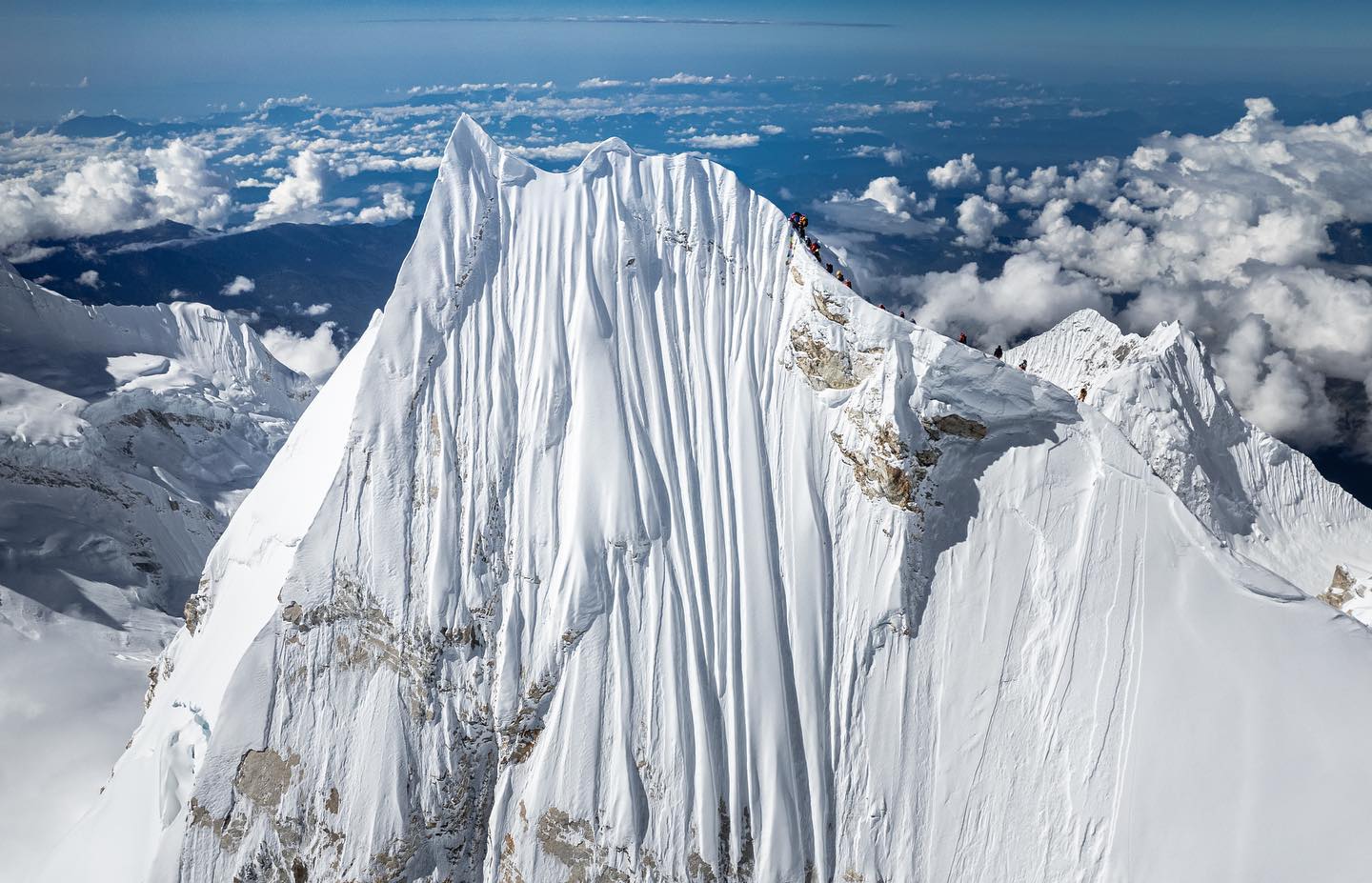
First in 45 years, 22 climbers make rare autumn ascent of Manaslu main summit

     First in 45 years, 22 climbers make rare autumn ascent of Manaslu main summit

The main peak is 8,163 metres high, and the mountaineering fraternity has lauded the climbers for making it to the ‘true summit’.

The team gathered at 8,100 metres, a place where people usually stop because they can’t climb to the true summit because of the tricky ridge and risk. The team then traversed down a little below and again climbed to the main summit, which is 8163 metres. Photo courtesy: Jackson Groves' Facebook page

Mountaineers have scaled the main summit of Mt Manaslu, the eighth highest mountain in the world, in autumn, accomplishing a feat not seen since 1976.

Led by Mingma Sherpa, better known as Mingma G, 14 Nepali and eight foreign climbers achieved the rare feat on September 27 for the first time in 45 years. The main peak is 8,163 metres high, and the mountaineering fraternity has called it the “true summit”.

“Many foreigners have been debating if Manaslu’s main summit can be climbed in the autumn season. On September 27, we proved it,” Mingma G told the Post over the phone.

“In fact, Mt Manaslu has been climbed every year, and even reaching the fore-summit, which is just below the main summit, is accepted as a successful ascent. The main summit is 6-7 metres higher than the fore-summit, and it has never been climbed since 1976,” he said.

                             Photo courtesy: Jackson Groves' Facebook page

As the last short section, a snow-covered rock outcrop, is very steep, climbers normally do not venture there during the autumn and winter.

“It’s like a sharp knife ridge which is daunting and dangerous. So climbers normally go up to the fore-summit and return,” said Mingma G, who was one of the members of the K2 winter ascent. K2, the world's second highest mountain in Pakistan, was climbed in winter for the first time in January.

“The new route was difficult, but we did it with perfection.”

The team started their summit push from Camp 4 at 3am on September 27, and reached the summit at 9:40am.

“I hope there will be no more fore-summits in the future. Top is always Top, no more ups, everything below you,” Mingma G wrote on his Facebook page. “It was not easy. The team gathered at 8,100 metres, a place where people usually stop because they can’t climb to the summit because of the tricky ridge and risk. Then, we traversed down a little below and again climbed to the main summit,” said Mingma G.

“We explored the new route. Hopefully, it will help climbers to follow the footstep.”

                                Photo courtesy: Jackson Groves' Facebook page

Tobias Pantel, who keeps a record of every technical climb on the Himalayan Database, posted on his Facebook page: “This is a big day for Himalayan mountaineering!”

The Himalayan Database, the expedition archives of American journalist Elizabeth Hawley, is a large digital and published record of mountaineering in the Nepal Himalayas since 1903. It has congratulated Mingma G and his team on reaching the “true summit” and the highest point of Manaslu in autumn 2021.

“This is the second time this point was reached during the autumn season, and the first time since 1976,” the Himalayan Database wrote on its Facebook page.

“As this is a significant day for Himalayan mountaineering and will have implications on how the Himalayan Database will report on Manaslu summits, the team will sit together to come up with a strategy on how to deal with future and past summits of the world’s eighth highest peak.”

The Manaslu summit has been marked by real confusion over what constitutes the true summit, and who historically and currently reached it, famed mountaineer Alan Arnette said in a blog post.

                                Photo courtesy: Mount Manaslu Facebook page

One of the climbers, photographer Jackson Groves, flew a drone near the summit and captured stills and footage of the historic summit.

“For Manaslu, the issue is the last few metres to the summit is across a heavily corniced snow ridge that is virtually impossible to place protections (ice screws, pitons, etc) to protect climbers from crossing it,” he said.

“So this year, Mingma, building on his winter K2 success, wanted to make a point. This time he proved he made his true summit with the help of drone pictures and videos he shot. Instead of crossing the corniced ridge, he is shown taking a drop-down route across a 70-degree face then climbing to what apparently is the true summit. It appears genuine,” he wrote.

“Then all the other climbers who claimed a summit this season without following his path will be noted as reaching the fore-summit.”

Thursday, August 26, 2021

NEPAL TREKKING COST 2022- SPECIAL RATES OF TREKKING WITH PRIVATE

#NEPAL #TREKKING #COST 2021- 2022  #SPECIAL #RATES OF #TREKKING WITH #PRIVATE #TRANSPORT  #www.friendshipworldtrek.com

Annapurna Base camp Trek - Friendship World Treks

Trekking Area: Muktinath Jomsom Trek Fly to Jomsom 
Trekking Days: 12
2 Pax: $1050 Per Person.
4 Pax: $745 Per Person.
6 Pax: $675 Per Person.
8 Pax: $645 Per Person.
10 Pax: $630 Per Person.
12 Pax: $625 Per Person.
15 Pax: $620 Per Person.

Trekking Area: Muktinath Jomsom Trek – Nayapul Drive
Trekking Days: 12
2 Pax: $1050 Per Person.
4 Pax: $795 Per Person.-
6 Pax: $750 Per Person.
8 Pax: $730 Per Person.
10 Pax: $720 Per Person.
12 Pax: $700 Per Person.
15 Pax: $680 Per Person.

Trekking Area: Annapurna Base Camp Trek (ABC)
Trekking Days: 14
2 Pax: $1170 Per Person.
4 Pax: $830 Per Person.
6 Pax: $780 Per Person.
8 Pax: $750 Per Person.
10 Pax: $720 Per Person.
12 Pax: $680 Per Person.
15 Pax: $690 Per Person.

Trekking Area: Everest Base Camp Trek (EBC)
Trekking Days: 13
2 Pax: $1195 Per Person.
4 Pax: $875 Per Person. -
6 Pax: $785 Per Person.
8 Pax: $775 Per Person.
10 Pax: $750 Per Person.
12 Pax: $735 Per Person.
15 Pax: $720 Per Person.

Trekking Area: Annapurna Base Camp Trek (ABC)
Trekking Days: 12
2 Pax: $1120 Per Person.
4 Pax: $765 Per Person.
6 Pax: $730 Per Person.
8 Pax: $700 Per Person.
10 Pax: $680 Per Person.
12 Pax: $650 Per Person.
15 Pax: $630 Per Person.

Trekking Area: EBC & GOKYO LAKE TREK
Trekking Days: 15
2 Pax: $1270 Per Person.
4 Pax: $930 Per Person.
6 Pax: $885 Per Person.
8 Pax: $850 Per Person.
10 Pax: $815 Per Person.
12 Pax: $790 Per Person.
15 Pax: $785 Per Person.

Trekking Area: Annapurna Circuit Trek ( Throng La Pass)
Trekking Days: 12 ( Besishar To Jomsom-Pokhara)
2 Pax: $1150 Per Person.
4 Pax: $850 Per Person.
6 Pax: $830 Per Person.
8 Pax: $810 Per Person.
10 Pax: $800 Per Person.
12 Pax: $780 Per Person.
15 Pax: $750 Per Person.

Trekking Area: Mustang Trek
Trekking Days: 12 (Jomsom to Jomsom)
2 Pax: $1905 Per Person.
4 Pax: $1490 Per Person.
5 Pax: $1450 Per Person.
6 Pax: $1430 Per Person.
8 Pax: $1400 Per Person.
10 Pax: $1380 Per Person.
12 Pax: $1350 Per Person.
15 Pax: $1330 Per Person.

Trekking Area: ABC Trek (7 Days)
Trekking Days: 07
2 Pax: $750 Per Person.
4 Pax: $525 Per Person.
6 Pax: $500 Per Person.
8 Pax: $480 Per Person.
10 Pax: $465 Per Person.
12 Pax: $455 Per Person.
15 Pax: $445 Per Person.

Trekking Area: Mardi Himal Trek
Trekking Days: 08 Days
2 Pax: $975 Per Person.
4 Pax: $690 Per Person.
6 Pax: $595 Per Person.
8 Pax: $580 Per Person.
10 Pax: $545 Per Person.
12 Pax: $500 Per Person.
15 Pax: $475 Per Person.

LANGTANG TREK- 7 DAYS TREK
2 Pax: $850 Per Person.
4 Pax: $750 Per Person.
6 Pax: $650 Per Person.
8 Pax: $550 Per Person.
10 Pax: $500 Per Person.
12 Pax: $480 Per Person.
15 Pax: $450 Per Person.


LANGTANG GOSAINKUNDA – 15 DAYS TREK
2 PAX: $1050 PER PERSON
4 PAX: $900 PER PERSON
6 PAX: $880 PER PERSON
8 PAX: $875 PER PERSON
10 PAX: $865 PER PERSON.
12 PAX: $800 PER PERSON.
15 PAX: $ 780 PER PERSON.

NOTE: FLIGHT TICKET IS EXTRA.

In the Above Cost It Includes:
1. Airport Pick-up and Drop Off,
2. Licensed and trained trekking guides,
3. potters for carrying goods and supplies,
4. Meal on full board (breakfast, lunch, dinner) basis during the trek
5. 3 Nights Accommodation in the Star Hotel in Kathmandu with B & B. (Bed
& Breakfast) and Pokhara.
6. All accommodation during the trek.
7. All meals and hot beverages during the trek.
8. Transportation to and from trail head by Private Transport.
9. All necessary documents and permits for trekking (where applicable)
10. National Park/Conservation Area entry Permit, Insurance, and
equipment for the staffs.
11. Coordination of quick Rescue service (Costs covered by your Insurance Plan)
12. Trekking staffs wages etc.
14. Welcome dinner in a Nepali Cultural Dance restaurant in Kathmandu.
15. Trekking Map, T-shirt, Trekking  certificate.
16. Exclusive of Medical Kit Bag
17. All Government and local Taxes
18. International Flight ticket re-confirmation.
19. Meals will be Start when your Trek starts.

Services and Cost Does not Included in Price:
1. International Airfares,
2. Travel/Trekking Insurance,
3. Excess baggage charges More than 16kg and hand bag more than 5 kg in
domestic flights.
4. Visa fees.
5. Airport Departure Taxes.
6. Drinks (Cold and Alcoholic) Rescue charge.
7. Tips for The staffs.
8. Expenses of Personnel nature and Permit and Liaison officer fee (where Applicable.
9. Meals during stay in the Kathmandu and Pokhara.
10. Domestic Ticket  of Lukla, Jomsom, Pokhara etc.
11. Extra Hotel in Kathmandu and Pokhara.

Annapurna Base Camp Trek


Day 1 - Kathmandu: Arrival Day
On your arrival, you will be greeted by our representative of Friendship World Treks Team at Tribhuvan International Airport (TIA) but make sure about our representative with a display board at the arrival gate. You will be then transferred to the hotel. We can either relax in the afternoon or hang around. You will have a dinner in a traditional Nepalese restaurant where we take pleasure in a Nepalese cultural program as well as food. Overnight at hotel.

Day 2 - Drive to Naya Pul and start trek to Ulleri, overnight at guesthouse
From Pokhara, we drive to Naya Pul and from Birethanti, we go up on the track to Ghandruk where we enjoy the stunning views of the enormous mountains. We go on along a range of small communities like Chimrong, Chane, Syauli Bazaar. After crossing the suspension bridge above Khumnu Khola, we will arrive at Ghandruk, a settlement where we can see stone houses inhabited by the Gurung people. Remarkably close towering views of Annapurna South, Fishtail and Himchuli peaks will enthrall us. Overnight at guesthouse.

Day 3 - Trek to Ghorepani, overnight at guesthouse
Today, we move further on from Ulleri to reach Ghorepani, one of the renowned spots of Annapurna region located at an elevation of 2856 meters. Our trek easily moves up to Banthanti (2250 m.) going across oak, rhododendron forest. We after that go on trekking to Ghorepani through Nangeythanti (2460 m.). Today we trek just about 5hours. Tonight at guest house in Ghorepani.

Day 4 - Climb to Poon Hill View point Trek to Tadapani / Chuile
Early morning today we march to Poonhill (3195m.). Here, you can take pleasure in the striking mountain views and eye-catching sunrise view. After an hour, we descend to Poonhill and have then constantly trek to Tadapani taking around 6 hours. Tadapani exactly refer to ‘Far water’ which means water is provided in this village from far away. The track ascends all along ridges and all the way through pine and rhododendron woods to Deurali. We move down to reach Banthanti, walk further on the twisting way to Tadapani. Overnight at trekkers lodge.

Day 5 - Trek to Sinuwa Hill, overnight at guesthouse
Moving down from Tadapani the path bestows good sights of the Modi valley. The trail then begins the long way up above the west shore of the Modi Khola. We get ahead of the village of Chhomrong which is located at the base of Himal Chuli. From Chhomrong the way moves down until Chhomrong Khola then we have a slow climb and reach Sinuwa Hill.

Day 6 - Trek to Dewrali, overnight at guesthouse
After move down from Chomrong then we have a challenging ascend to Sinuwa we keep on trekking up through the forests going across the small settlement of Bamboo and Doban till we ultimately reach Himalayan Hotel. Overnight at Dewrali.

Day 7 - Trek to Machhapuchhre Base Camp Via Annapurna Base Camp overnight at guesthouse
We start from Machhapuchhre Base Camp and we make a temperate climb through a river to abruptly above the mountain side. Walking from Deurali, we will arrive at a point where we will be encircled by huge snow-covered peaks. Moving ahead to Machhapuchhre Base Camp we reach at a set where the views of Mt. Annapurna South, Annapurna I, Himchuli, Annapurna III and, definitely, the Machhapuchhre itself enthralls us.
From Machhapuchhre base camp (3900m.), we continue to Annapurna base camp. The area is encircled by the peaks and is recognized as Annapurna Sanctuary. This set gives you an impressive view of huge peaks including Annapurna I, Barah Shikhar, Annapurna South and many other giant peaks. We today walk for around 2 to 3 hours.

Day 08 - With the memory of massive Annapurna I and ranges, trek back to Bamboo, overnight at guesthouse
We move early morning and witness the wonderful sunrise over the peaks from Annapurna Base Camp. Then, we move down from Annapurna Base Camp via Deurali, Dovan and eventually reach Bamboo. We gradually, walk down to reach the valley where we again see the waterfalls that pours down from a high above. Tonight, we stay in Bamboo at guesthouse.

Day 9 - Trek to Jhindu Danda, overnight at guesthouse
Leaving Dovan we have a vertical way up to the Kuldi Ghar then Sinuwa, following the stone steps that take us to Lower Chhomrong. After that, we ascend on the stony steps that lead us to Upper Chhomrong. From Chhomrong, we walk down to Jhinu Danda. Here, we will take bath at natural warm water spring. Overnight at guest house in Jhinu Dada.

Day 10: Trek to Deurali or Potana
From Jhinuwa hot spring we start our trek to Deurali. Deurali is a good view point to look at the Annapurna range and the route you have trekked in the last days. Overnight at Lodge.

Day 11: Trek to Phedi and drive to Pokhara / Fly To Kathmandu.
We make a three hour trek downhill to Phedi where our vehicle awaits us to transfer us to Pokhara. Afternoon is free to explore the town. Overnight at Hotel.


#Annapurnabasecamptrek #Annapurna #Nepal #Friendshipwordtreks 


Wednesday, March 31, 2021

Mt Everest Is Overcrowded With Climbers So Nepal Has Banned Photos of Them

       Mt Everest Is Overcrowded With Climbers So Nepal Has Banned Photos of Them

The government can ban anyone found violating tourism rules from entering the country for up to five years or from mountaineering in Nepal for ten years.

If there’s one picture of Mount Everest you remember, it is likely a viral image of a serpentine line of climbers waiting for their turn to reach the summit. 

But that may be the last of its kind after Nepal introduced earlier this month to prevent “filming, taking pictures or recording videos of things other than the expedition or mountaineering of the expedition team or team members.” 

                                                  The Picture is taken by Elia Saikaly 

The new rule is actually a clearer, reworded version of existing guidelines intended to protect the “security and reputation” of Nepal. But it goes further, just as the country gears up to welcome climbers again a year after the COVID-19 pandemic halted last year’s season. 

“Climbers are free to take photos and videos of their expedition and team members, but they cannot take photos and videos of other things that may cause controversy and hurt national integrity and social harmony,” Mira Acharya, director with the Department of Tourism, told VICE World News.

“In the past many climbers have told us that they were unaware of the rules so we had to excuse their violations. By issuing this notice, we’re making sure that expedition teams, operators and members are informed of rules and regulations before they start their expedition.”

The government can ban anyone found violating tourism strictures from entering the country for up to five years or from mountaineering in Nepal for ten years.

Home to the world’s eight highest mountains, Nepal is one of the top destinations for climbing enthusiasts. In 2019, the government earned $5.07 million in revenues from the issuance of climbing permits, of which Everest alone accounted for $4.05 million. 

While the government has justified the new protocols on grounds of better management of expeditions, critics believe that it is an attempt to control negative publicity after the viral photo of the traffic snarl at the top of the mountain.

The 2019 image taken by record-smashing climber Nirmal Purja was carried by news outlets worldwide and triggered a debate on overcrowding on Mt Everest, and whether the government was possibly prioritizing profit over climbers’ safety. The day the photo was taken, a record 223 climbers reached the summit, the highest to date. That year also recorded the highest number of deaths—10—on Everest. 

Earlier this year, Nepali authorities were caught off guard by an Indian news broadcast showing footage from Everest. In the clip, the anchor can be seen flying over the peak in a helicopter, and making arguments for India’s claim on the world’s highest mountain. The anchor later apologised after Nepalis criticised his claims. It was also revealed later that he had not obtained permission to film in the region. 

“Both these incidents along with a few others have forced the department to be more proactive when it comes to controlling content emerging out of Everest,” said journalist Sangam Prasain, who covers tourism and business for the Kathmandu Post. “Which is why they’re taking the effort to announce these rules this year even though they have been existing for many years.”

The rule is drawing flak by the climbing community for its impracticality and for the alleged failure of the government to focus on more important issues. 

Mount Everest 8848.86M by Nima Photography - Nepal 

“This decision once again paints the Nepal government in a negative light,” said Ang Chiring Sherpa, former president of the Nepal Mountaineering Association. “How do they plan to control what image or video people take at a time when most people have cell phones and access to social media.”

Sherpa said the government announced similar rules banning the distribution of photos and videos of others without consent back in 2008 ahead of the Beijing Olympics. 

“At the time there were some talks about cancelling all expeditions from the Nepal side to avoid any controversy on the mountain as the Olympic flame was being carried to the top of Everest from the Chinese side,” Sherpa said. 

“We requested the Nepal government to instead come up with rules that would allow us to carry on with our expeditions, and that’s what happened.”

Saturday, January 30, 2021

Nepal to allow unrestricted entry to vaccinated tourists

    Nepal to allow unrestricted entry to vaccinated tourists

Nepal is considering allowing unrestricted entry to vaccinated tourists in a bid to boost the morale of the moribund tourism industry ahead of the upcoming spring peak season, Tourism Minister Bhanu Bhakta Dhakal said on Friday.

There will be no quarantine and coronavirus insurance requirements, and all visitors will need to produce is proof of having had the shot. Many countries have started issuing a vaccine certificate or vaccine passport to international travellers.

“In order to ease restrictions on travel, we are allowing tourists to travel freely if they produce a certificate that proves they have been vaccinated,” Dhakal told a media briefing here on Friday. He said the ministry had also recommended resuming issuing on-arrival visas to all tourists at Kathmandu's Tribhuvan International Airport.

The Seychelles became the first country in the world to welcome vaccinated tourists without quarantine requirements.

Dhakal said the government was also preparing to extend the 72-hour validity of negative Covid-19 test reports for those who have not been vaccinated.

Currently, all visitors to Nepal above age five must have a negative PCR test obtained not more than 72 hours before departure, according to the Department of Immigration.

A mandatory seven-day hotel quarantine, with a second negative PCR test on the fifth day after arrival, is required. Trekkers and mountaineers must also have insurance coverage worth $5,000.

The government still has not resumed granting on-arrival visas at Kathmandu airport, except to officials of diplomatic missions and non-resident Nepalis.

“We are taking a few proposals which we have discussed with the Covid-19 Crisis Management Centre to the cabinet for its approval,” said Dhakal. “We expect that these measures will permit tourists to come to Nepal without hassles.”

Nepal imposed a complete lockdown in March last year that kept out all foreign sightseers during the second peak tourist season.

Travel trade entrepreneurs said that excepting mountaineering expeditions, advance booking for the spring season still had not picked up due to travel-related restrictions.

Nepal launched a nationwide Covid-19 vaccination drive on Wednesday, and plans to immunise 72 percent of its 30 million population in three months.

A day after starting the inoculation campaign, the government decided to re-open 16 border points with India and China, allowing citizens of the respective countries to travel to Nepal. Earlier, the government re-opened 14 border crossings.

Minister Dhakal said that the re-opening of the land points would facilitate Indian tourist movement into Nepal, especially during the upcoming Maha Shivaratri festival on March 11 when thousands of Indian pilgrims visit the Pashupatinath temple in Kathmandu.

According to the Health Ministry, the country reported 157 new coronavirus infections among 3,221 PCR tests done in the past 24 hours, pushing the overall infection tally to 270,745. As of Friday, the active case count stood at 3,022.

On January 23, the local administration in Nepal's Everest region threw the door wide open to tourists by removing all Covid-related restrictions in a fresh attempt to woo back trekkers to its popular trails.

Sightseers visiting the Everest region are no longer required to submit a negative Covid-19 RT-PCR test report or go into quarantine.

Last March, the government stopped issuing on-arrival tourist visas to nationals of all countries besides cancelling spring mountaineering expeditions including those to Everest.

The decision came a day after the World Health Organisation declared the Covid-19 outbreak a pandemic, and urged countries to take precautionary measures.

In October, Nepal opened the door a crack for trekkers and mountaineers, nearly seven months after the country imposed a complete lockdown.

In light of the Covid-19 pandemic, the hospitality industry continued to be significantly and adversely impacted even after the government lifted the lockdown; and things are unlikely to improve in the next few months, said hotel owners.

The coronavirus crisis resulted in an 80.78 percent drop in tourist arrivals from the previous year, making it the worst year-on-year fall in tourist numbers since Nepal opened the door to foreign visitors in the 1950s.

According to the statistics of the Department of Immigration, Nepal received 230,085 foreign tourists last year, which is about equal to the number of visitors that came to the country in 1986.